
After 29 Years Fitting Orthotics, Here Is The Truth
Health & Movement · Rated 4.8 ★ by 1,000+ customers
“After 29 Years Fitting Orthotics, I Have To Tell You The Truth: The Support Is The Problem.”
A foot-health specialist breaks ranks on why your heel pain always comes back — and the one thing nobody in the industry wants to sell you.
By Dr. Raymond Whitfield · Foot-health specialist, 29 years in practice

For most of my career, I did exactly what I was trained to do. A patient would come in with that stabbing first-step pain in the morning. I’d nod, measure their arch, and send them home with a custom orthotic. Three hundred dollars. Sometimes five.
And for a few weeks? They felt better. Then they came back. Same pain. So I’d prescribe a “more supportive” shoe. Then a night splint. Then a firmer insert.
It took me far too long to admit what was really happening. I wasn’t fixing anyone. I was building repeat patients.
The part that kept me up at night
Here’s what we don’t print on the box. Your foot is not a dead platform that needs propping up. It is a living system — 33 joints, 26 bones, and over 100 muscles, ligaments and tendons that are supposed to do work every time you take a step.
Support takes that work away. And a muscle that never does its job does not stay the same. It wastes.
Think about an arm in a cast for six weeks. When the cast comes off, the arm is thin and weak. Nobody is surprised — you immobilised it. Now think about what a “supportive” shoe does to your foot. Every day. For years.
The more support you add, the less your foot is allowed to work. The weaker it gets. The more it hurts. So you reach for more support — and the cycle tightens. That is not a flaw in the products. That is the product.
Why everything you’ve already tried didn’t work
I want you to stop blaming yourself. You did everything you were told.
- The custom orthotics → added support.
- The cushioned “walking” trainers → added support.
- The arch inserts from the chemist → added support.
- Rest, ice, rolling a ball under your foot → eased the symptom for a day.
Every one of those is the same idea wearing a different label. It was never that you failed. They were all the same answer to a problem that needed the opposite.
The one thing nobody wanted to sell
There is no money in telling someone their foot can get strong on its own. But a foot is a muscle system, and muscle responds to one thing: being allowed to work again — slowly, and the right way. That means the opposite of everything above:
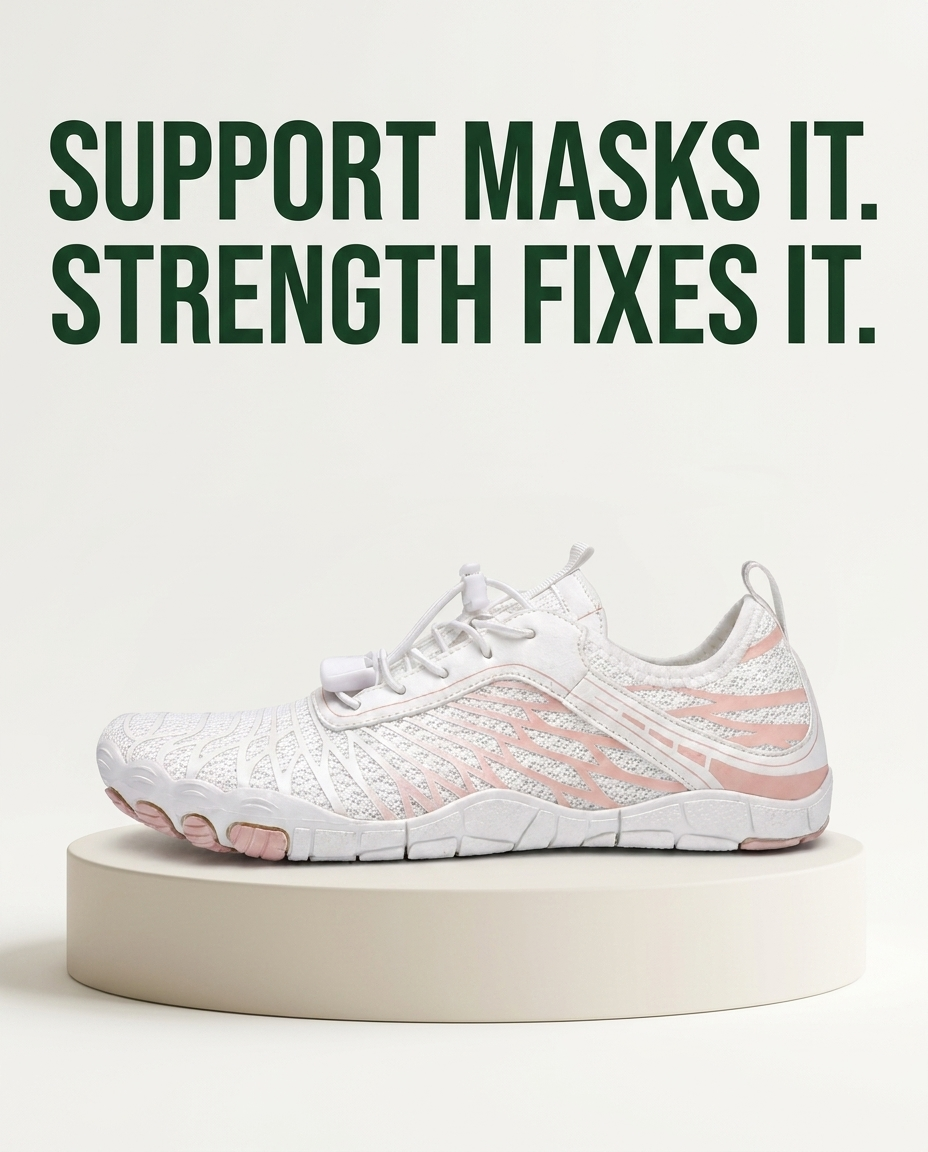
- A wide toe box — so your toes spread and grip the way they were built to.
- Zero drop — heel and toe level, so weight loads naturally instead of tipping forward.
- A thin, flexible sole — so the nerves and small muscles in your foot feel the ground and switch back on.
This category has a name — barefoot / minimal footwear. In my opinion it is the only design that helps rebuild the foot instead of replacing it. Rewired is built to do exactly that — and to be worn all day without looking like a medical device.

“But won’t going barefoot hurt at first?”
Honestly? For the first week or two, your feet will talk to you. That is not damage. That is muscles that have been asleep for years waking up — the same as your first week back at the gym.
That is why Rewired comes with a simple 4-Week Rebuild Guide — start with an hour a day and build from there — so your feet strengthen on a curve instead of being thrown in the deep end. Done the right way, most people stop thinking about their feet within a few weeks. (Soft claim — individual results vary.)
What this actually costs you
The orthotics route: $200–$500, and you will be back for more. The endless “supportive” trainers: a few hundred a year, forever. The physio, the inserts, the splints: thousands, to stay in the same place. Rewired is $65. Once. With the rebuild guide included.
The 60-Night Feet-Back Guarantee
Wear them. Follow the guide. If your feet do not feel like they are finally working for you instead of against you — email inside 60 nights for a refund. Keep the guide.
— Dr. Raymond Whitfield
Rewired footwear is designed to support natural foot movement. It is not intended to diagnose, treat, cure or prevent any disease or condition, including plantar fasciitis. Individual results vary. If you have diabetes, neuropathy, or a diagnosed foot condition, consult a qualified healthcare provider before changing your footwear.